%20(1).png)
— THE STRUCTURE THAT GUIDES US
Two strategic areas, three cross-cutting axes.
— AREA 1
Intercultural public health
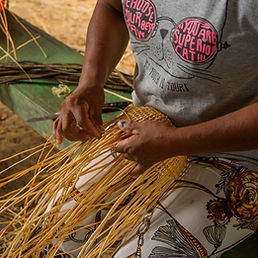
What is it about? — Indigenous, Afro-Colombian, and farmer communities in Colombia's dispersed rural areas face significant public health challenges — the product of structural inequities.
When seeking solutions to these challenges, external actors frequently prioritize a Western scientific mindset: objectives and procedures learned primarily in urban universities. This ignores and displaces the knowledge and care systems that each community, across its many human layers, has built over centuries of engagement with its own challenges and within its own natural, social, and cultural environments.
The interculturality adopted by Sinergias means that this body of local knowledge enters into dialogue with external knowledge — and draws from it wherever mutual respect makes room for it.
Components:
-
Primary health care
-
Maternal and child health
-
Sexual and reproductive healt
-
Community mental health and violence prevention
— AREA 2
Social wellbeing with territorial focus and community autonomy

What is it about? — A community's wellbeing does not depend exclusively on its physical and mental health, but on a multiplicity of factors that affect it, directly and indirectly. One of them is its capacity to make decisions about its territory, defend its rights, manage its resources, and participate in the spaces where decisions that affect them are made. A community with strong leadership, the ability to engage with the State and other institutional actors, and its own governance tools is a community that can sustain its wellbeing over time — without depending on the presence of external actors.
That is what this area pursues: strengthening the strategic capacities that communities already have in governance, leadership, communications, and collective organization, so that they can engage more forcefully with the public policies that define their living conditions, and so that their comprehensive wellbeing is sustainable.
Sinergias accompanies the strengthening of those capacities — it does not replace them, nor redesign them — so that each community has more tools to act on its own reality.
Components:
-
Education for diversity
-
Community leadership and communications training
-
Productive projects and food sovereignty with a biocultural approach
-
Healthy environments for life

— CROSS-CUTTING AXES
The dimensions that shape all of our work
.jpeg)
1— Gender, diversity and inclusion
Inequities do not affect everyone in the same way. Women, persons with disabilities, sexual and gender minorities, different ethnic groups, and young people face specific barriers. And those barriers rarely come alone: when they overlap, disadvantages deepen. That is why this is not an additional component of our work: it is a lens that shapes everything we do — from project design to team composition — and that promotes: work with and for women; work with and for girls, boys, and adolescents; the participation and inclusion of persons with disabilities; and mental health in communities.
.jpeg)
2— Rights guarantee and protection
The communities we work with are rights-holders. Health and social wellbeing work cannot be separated from that awareness, which is why we incorporate it at the territorial, cultural, and political levels. Sustainable wellbeing requires that communities know their rights and are able to defend them in diverse spaces and instances. That is why we accompany and support the defense of the legal and constitutional protections of individuals, communities, and ecosystems.
3— Advocacy and knowledge management
Sinergias promotes horizontal dialogue between community leadership and the official spaces where public policies relevant to the territories are designed and implemented. One of the key inputs for this advocacy is the body of knowledge that each community holds about what works, what does not, under what conditions, and why. That is why we seek to bring that knowledge into dialogue with academia — so that advocacy reaches not only those who make direct decisions, but also the debates that produce knowledge. This dialogue is built by establishing alliances with educational institutions and generating research processes that place community knowledge and academic knowledge on equal footing.
.jpeg)